

Why Video Retention Planning Is Often an Afterthought — and Why It Shouldn't Be
Most security camera systems are installed with the default NVR settings left in place. That usually means 7–14 days of retention before footage overwrites itself. For many incidents — slip-and-fall claims, employee theft investigations, or insurance disputes that surface weeks after an event — 14 days is simply not enough. By the time the claim arrives, the footage is gone.
Proper video retention planning protects your business legally, satisfies insurance requirements, and ensures your investment in CCTV actually pays off when it matters most.
Florida-Specific Retention Considerations
Florida has no single statute mandating how long private businesses must retain surveillance footage. However, several regulatory frameworks and industry standards apply:
- Florida Statute 768.0710 — slip-and-fall liability. Businesses can be liable if they had notice of a hazard. Footage proving the hazard was immediately corrected is a key defense. Retain at least 60 days.
- Hospitality / lodging — Most hotel insurance policies in Florida require 30 days minimum for common areas.
- Schools and government facilities — Many districts require 60–90 days; some public records requests can mandate longer holds during active investigations.
- PCI DSS (retail with card processing) — While PCI DSS itself doesn't mandate camera retention, it requires you to be able to produce evidence during audits. Most QSAs recommend 90 days.
- Healthcare (HIPAA environments) — Cameras in patient areas may fall under HIPAA breach notification requirements. Consult legal counsel for retention policies in these environments.
How to Calculate Your Storage Requirement
The storage you need depends on four variables: number of cameras, bitrate per camera, hours of recording per day, and retention period. Use this formula:
Storage (TB) = cameras × bitrate (Mbps) × 3600 sec × hours/day × days ÷ (8 × 1,000,000,000) × 1.2 overhead
For practical use, a simplified table (H.265+ at 4MP):
| Cameras | H.265+ Bitrate | 30 Days | 60 Days |
|---|---|---|---|
| 8 | 2 Mbps avg | ~5 TB | ~10 TB |
| 16 | 2 Mbps avg | ~10 TB | ~20 TB |
| 32 | 2 Mbps avg | ~20 TB | ~40 TB |
Note: H.265+ sub-stream and smart event recording can cut these figures dramatically — some sites achieve 30-day retention on 16 cameras with a single 8 TB drive by recording at reduced bitrate on "quiet" overnight hours and full bitrate only during business hours.
Smart Recording Modes That Extend Retention
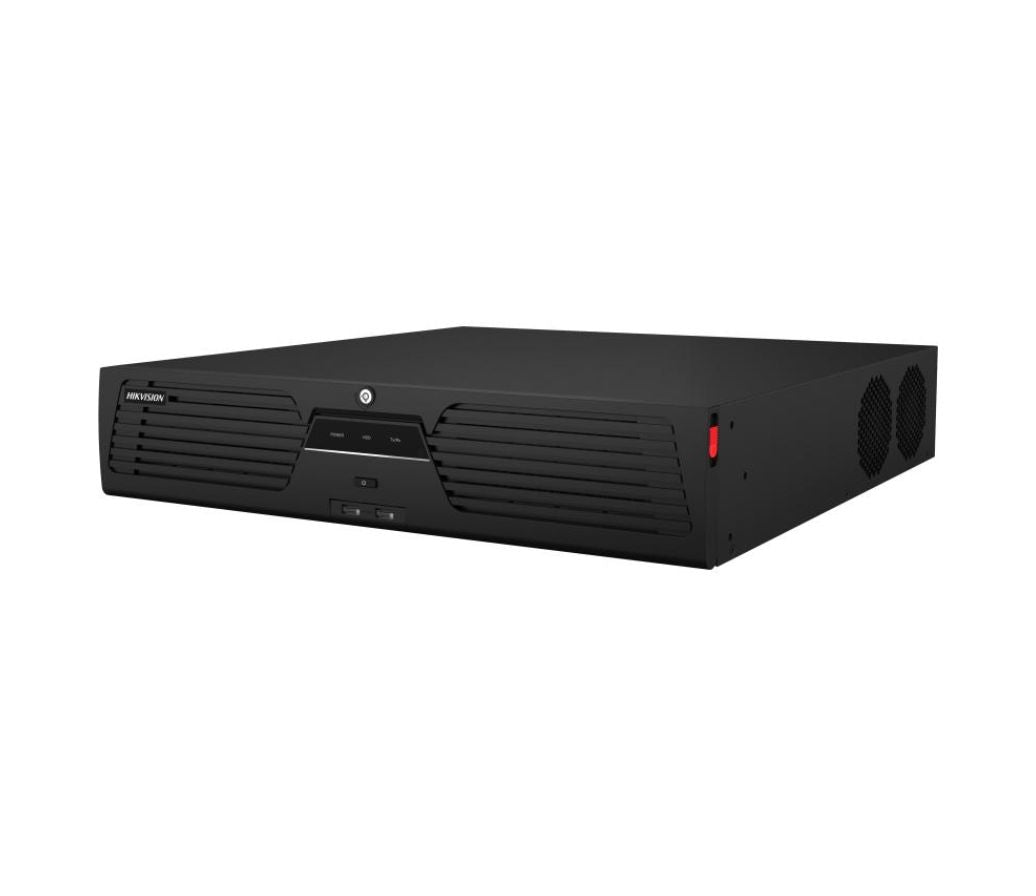
Modern and Hanwha NVRs offer several intelligent recording schedules that extend effective retention without adding more drives:
- Motion-only recording: Camera records at high quality only when motion is detected. A parking lot camera active 8 hours/night may only have 30–45 minutes of actual motion events per night — cutting storage by 80%.
- AcuSense event recording: Records full-quality clips only when a human or vehicle is detected. Eliminates hours of empty corridor footage.
- Dual-stream recording: Record main stream at 4MP for incidents, sub-stream at 720p continuously. Some NVRs archive the sub-stream for 90 days and main stream for 14 days — giving you both depth and breadth.
- Schedule-based recording: Higher quality and frame rate during business hours; reduced quality (or motion-only) overnight and on weekends.
When to Use NAS or Cloud Backup
For critical footage or long-term archives required by insurance or compliance, consider a secondary backup:
- Local NAS: QNAP or Synology units connect via iSCSI or SMB to your NVR. Cost-effective for on-site archives up to several hundred TB.
- Cloud backup ( HikCloud / Hanwha Wave): Automatic off-site backup for key camera streams. Best for high-value cameras (entrances, cash registers) where footage must survive a fire or break-in targeting the NVR itself.
- Redundant RAID drives: RAID-1 (mirroring) in a 4-bay NVR means a single drive failure doesn't lose footage. Critical for 24/7 commercial sites.
Legal Holds and Incident Preservation
When an incident occurs that may lead to a claim or lawsuit, immediately export and preserve the relevant footage to an external drive. Do not rely on the NVR overwrite cycle stopping on its own. Best practice:
- Export a 2-hour window around the incident from all relevant cameras
- Save to at least two separate external drives (USB or NAS)
- Note the date, time, camera names, and NVR serial number in a written log
- Store one copy off-site
- Notify your insurance carrier within 24 hours if it's a significant incident
Recommended Retention Minimums by Business Type
- Convenience store / gas station: 30 days
- Restaurant / bar: 30 days
- Office building: 30–60 days
- Retail store: 60 days
- Apartment / HOA: 30 days
- Hotel: 30 days (check your policy)
- School: 60–90 days
- Government / municipal: 90+ days
Need help sizing storage for your Florida facility? IDS CCTV offers free system design consultation. Call (954) 903-0007 or contact us online and we'll calculate the exact storage configuration for your camera count and retention target.