
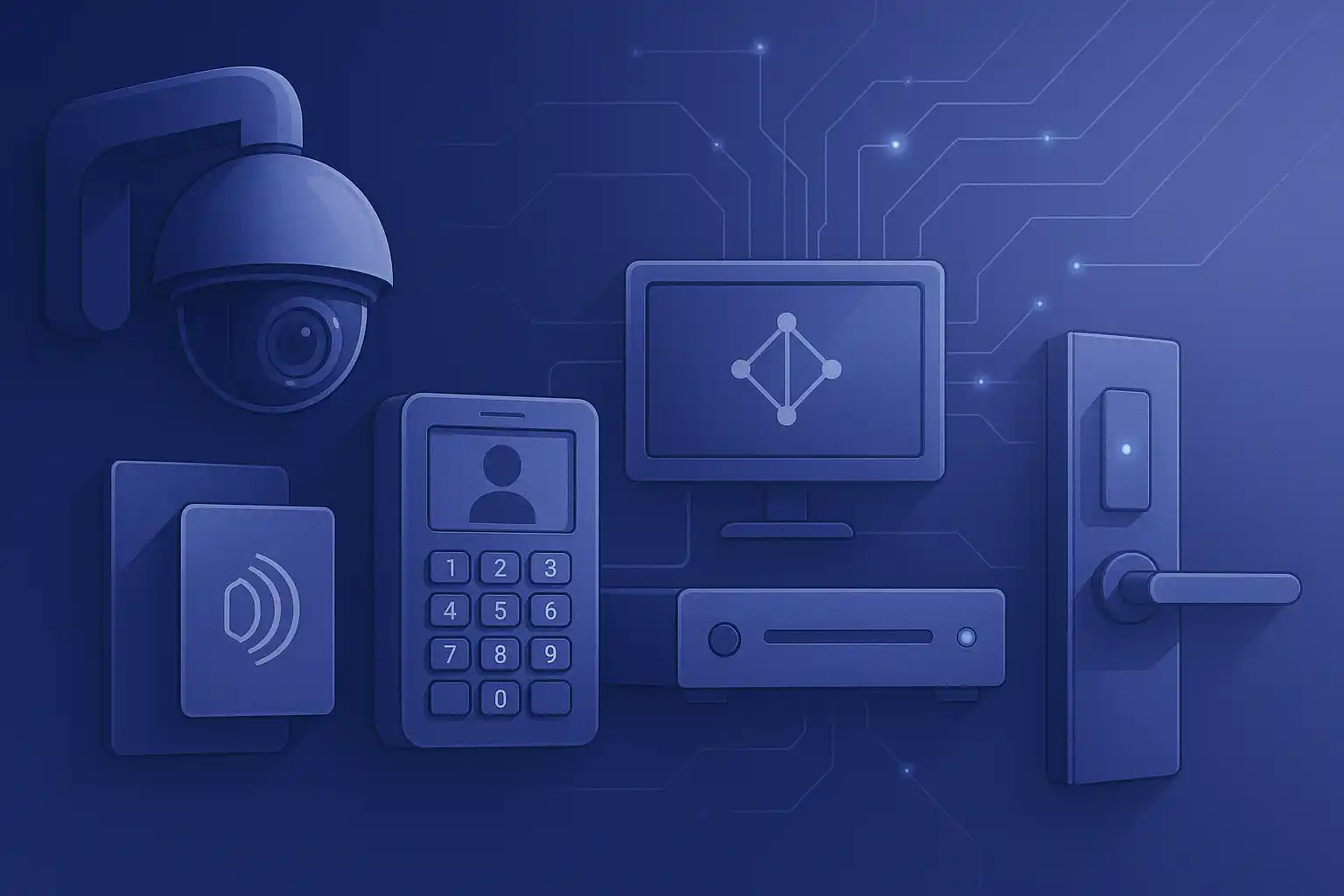
Why Standalone Systems Leave Gaps
Many Florida businesses install a card access system for door control and a separate CCTV system for monitoring. On paper, this covers the bases. In practice, these siloed systems create blind spots: when a door access event occurs, security staff must manually search the NVR for the footage from the corresponding time and camera. For busy facilities with dozens of daily access events, this is impractical — meaning footage is rarely reviewed proactively and incidents are only investigated after damage is already done.
Integrated access control and CCTV solves this by linking every door event — access granted, access denied, forced entry alarm, door held open — to the corresponding video clip automatically. The result is an audit trail that's both searchable and visualizable in a single interface.
How Integration Works
Modern IP-based access control systems communicate with IP cameras and NVRs via one of three methods:
- Native integration: Same-brand systems ( access control + NVR) share a protocol natively. Door events appear as bookmarked clips in the NVR timeline. Setup is plug-and-play in iVMS-4200 or Hik-Central software.
- VMS integration: A Video Management System (such as Milestone, Genetec, or Hanwha SSM) serves as the unified platform connecting different brands of cameras and access controllers. Higher cost but maximum flexibility.
- API/webhook integration: Some systems expose REST APIs that allow custom event linkage. Useful for integrating with third-party alarm or PSIM platforms.
Key Integration Points for Florida Facilities
Entry and Exit Doors
Every controlled entry point should have a dedicated camera with a clear view of the door, positioned to capture face-level images. When the access controller logs a credential presentation, the NVR bookmarks the video at that exact timestamp. This creates a searchable event log: "Show me everyone who entered Storeroom B on the night of [date]."
Tailgating Detection
Tailgating — an unauthorized person following an authorized person through a controlled door — is among the most common access control vulnerabilities. AcuSense cameras positioned at controlled entry points can count people passing through a doorway and raise an alert when the count exceeds one per access event. This is particularly valuable for server rooms, pharmacy areas, and secure storage.
Forced Entry and Door Held Open Alarms
Door contact sensors integrated with the access controller can detect forced entry or a door held open beyond a configured time. These alarms can be configured to:
- Trigger a high-priority alert on the NVR monitoring screen
- Pop up the relevant camera feed on a guard station monitor
- Send an immediate push notification to facility management
- Activate a local audible alarm at the door
Video Intercom Integration
Video intercoms (door stations with camera, microphone, and speaker) are often the first point of visitor management before access is granted. 's DS-KV series and similar models connect directly to the NVR, recording every intercom session. Visitors can be granted remote access by facility staff viewing the intercom feed on their phone — without the facility needing a staffed reception desk.
Recommended Equipment for Florida Businesses
- DS-K1T671TM — Face recognition terminal with temperature screening. Ideal for office building lobbies and healthcare facilities.
- DS-K2210X — 2-door access controller. The core unit for most small commercial deployments.
- DS-KV8113-WME1 — Villa-style door station with HD camera and two-way audio. Works with NVR integration.
- DS-K1A802F-B — Fingerprint card reader for high-security areas where card-only access is insufficient.
Planning Considerations for Florida
Florida's climate affects hardware selection. Outdoor access readers should be NEMA 4-rated (weatherproof) and rated for direct sun exposure — unrated readers in direct South Florida sun have a service life of under two years. Verify UL294 (access control) and UL 2050 (monitoring station) certifications when specifying equipment for insurance-rated systems.
For multi-tenant commercial buildings, ensure the access control system supports multi-tenant credential management — different credential sets for different floors, areas, and tenant organizations within a single system.
Getting Started
The most practical starting point for most Florida businesses is a native integration combining their access control line with an AcuSense NVR. This covers 80% of integration use cases at the lowest total cost, with a familiar single-vendor support chain. For larger or multi-brand environments, a VMS platform is worth the additional investment.
IDS CCTV supplies the complete access control and CCTV lineup. Our team can design an integrated system for your Florida facility from the ground up. Call (954) 903-0007 or request a quote online.