

The Problem with Traditional Motion Detection
If you've ever managed a conventional security camera system, you know the frustration: dozens of motion alerts every day triggered by swaying trees, passing headlights, weather changes, or insects flying past the lens. Security teams quickly learn to ignore these alerts, and the monitoring system becomes theater rather than protection.
Traditional motion detection works by analyzing pixel changes between consecutive frames. Any change—regardless of whether it's a person, a car, an animal, or a shadow—triggers the alarm. It's simple, computationally cheap, and largely useless for proactive security.
How AcuSense Works
AcuSense is a deep learning-based detection platform built directly into the camera's processor (or the NVR, for non-AcuSense cameras). Instead of detecting any pixel movement, AcuSense classifies what's causing the movement.
The on-device neural network has been trained on millions of images to recognize two specific classes of objects:
- Humans — pedestrians, people entering or exiting, individuals in restricted areas
- Vehicles — cars, trucks, motorcycles, vans
An alert is only triggered when a human or vehicle is detected. A dog walking through the frame, a tree branch moving in the wind, or rain hitting the lens? No alert. This transforms the alert system from noise to signal.
AcuSense Detection Modes
Intrusion Detection
Define a virtual boundary within the camera's field of view. When a human or vehicle crosses that boundary, an alert fires. Common use: perimeter fencing, restricted zones, after-hours building access.
Line Crossing Detection
Draw a virtual line across a doorway, road, or pathway. Alerts trigger when a person or vehicle crosses in one or both directions. Common use: building entrances, loading docks, driveways.
Region Entrance/Exit Detection
Monitor a defined area and alert when people or vehicles enter or exit it. More flexible than line crossing for monitoring complex zones.
Unattended Baggage / Missing Object
Available on higher-end AcuSense models: alerts when an object is left in a defined area or when a previously present object is removed. Common use: airports, warehouses, retail.
False Alarm Reduction: The Numbers
's own testing and independent field reports consistently show AcuSense reduces false alarms by 90%+ compared to traditional pixel-motion detection in typical outdoor environments. For a busy commercial property that might receive 200 false alerts per day with traditional detection, AcuSense typically reduces this to under 20—most of which are legitimate events.
AcuSense in the Camera vs AcuSense in the NVR
There are two ways to get AcuSense functionality:
- Camera-Side AcuSense — The AI processing happens on the camera's own chip. Each camera independently classifies motion and sends only human/vehicle alerts to the NVR. This is the most scalable approach—there's no limit to how many cameras you can add.
- NVR-Side AcuSense (DeepinView) — Standard (non-AcuSense) cameras send all video to a DeepinMind NVR, which performs the AI classification. This is cost-effective for mixed installations where you already have non-AI cameras, but the NVR has a channel limit for AI processing (typically 8–16 channels depending on model).
AcuSense vs Competing AI Platforms
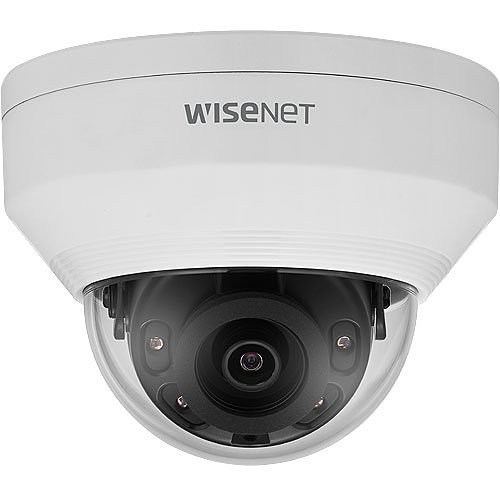
Hanwha Wisenet AI and Uniview's Perimeter Protection work on the same deep learning principle as AcuSense. The key differences:
- Accuracy: All three platforms perform similarly for person/vehicle detection. Hanwha edges ahead for complex analytics (crowd density, slip/fall).
- Price: AcuSense cameras are widely available at competitive wholesale prices. Hanwha AI models carry a slight premium.
- Ecosystem: AcuSense integrates natively with NVRs and iVMS-4200. Hanwha AI works with Wisenet WAVE VMS.
Is AcuSense Worth the Extra Cost?
AcuSense cameras typically cost $20–$60 more than equivalent non-AI cameras at the same resolution. For any commercial installation where false alarms create real operational cost—security staff time, response team dispatches, insurance implications—the premium pays for itself quickly. For residential or low-priority environments where occasional false alerts are acceptable, standard cameras remain a practical choice.
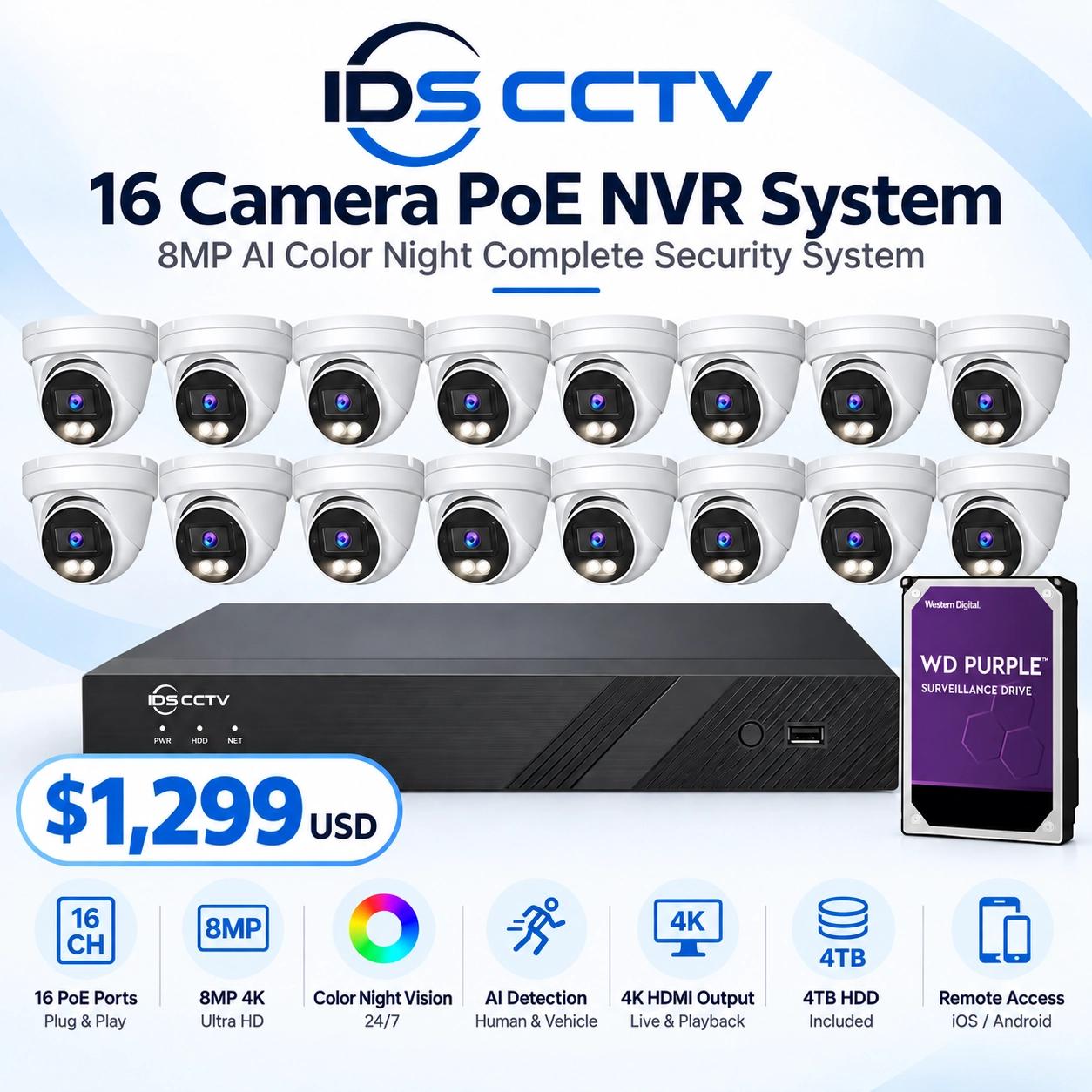
Shop AcuSense Cameras at IDS CCTV
IDS CCTV stocks the full AcuSense range at wholesale pricing from our Hollywood, FL warehouse. Same-day shipping statewide. Browse our AcuSense camera catalog or call (954) 903-0007 for expert guidance on the right model for your project.